JP Morgan Losses Looming
The JP Morgan
(JPM) trading blunder
could result in a $100 billion loss, a contagion of its massive portfolio, and
even the wipeout of its entire asset base. Even worse, these extremely risky and
potentially-illegal actions on behalf of the CIO office and the "London Whale"
could be the unexpected "shock" that breaks the market, derails the Fed's huge
monetary stimulus, and sends us back into a global recession.
The JP Morgan Shock
The entire
world has forgotten about or ignored what could be the upcoming "shock" that
puts the global financial system in severe jeopardy. To make matters much, much
worse - I don't think anyone even has a clue as to what is really happening.
Investors, economists, financial powerhouses, top business executives,
politicians, lawmakers,
consumers, students, governments, and even central banks are completely
confused. None of them are expecting what I will describe
below.
There is one
event that may ultimately solve the mystery of the global economy. This event
would not only plunge the economy back into a deep recession and lose investors
hundreds of billions of dollars, but it could bring about the collapse of some
of the world's largest financial institutions and even render central bank
stimulus and QE completely ineffective and futile. This event is by no means a
guarantee; its probability is even likely under 5 percent. But this event has
all the necessary ingredients to culminate into a major panic. Together with
slowing global economies and an extremely unstable financial system, this could
be the next Lehman Brothers.
This event is
JP Morgan's huge trading mistake. The massive losses that were racked up
starting in April and May 2012 are by no means over.
What has been represented by JP Morgan as a trading mistake and "hedging"
strategy with an initial estimated loss of $2 billion, was really a leveraged
and speculative bet that could soon infect JP Morgan's entire portfolio and
result in losses of $100 billion.
The Global Economy and Huge Underlying
Risks
Most investors
already know about the very weak economic growth, European financial crisis,
Chinese slowdown, Middle East tensions, and dangerous Fed actions. All are huge threats
and may drag the global economy into a double-dip recession. But most
investors don't
know if the fears are overblown; they don't know if central banks will be
successful in boosting the economy; and they don't know the real risks out
there. Most investors are either overly-optimistic, over-confident that they
will be able to pull their money out quickly, following the crowd, or simply
taking way too much risk unnecessarily. After a 115% + rally, and only 7% away
from the all-time stock market highs, it's just not worth staying invested right
now.
This was my
warning to my friends on September 25, 2012:
Take your money out of stocks and gold
NOW!!!
$SPY $GLD $AAPL
$FB $GOOG $MCD $CAT $JPM
Way
too much risk, stock market is only 7% away from the all-time highs (and the
economy is nowhere near where it was), Apple has failed to stay above $700 and
will potentially never make new highs ever again, Google might have just put in
a top, Facebook continues to fail, China is slowing down tremendously and could
enter recession, Europe has a financial crisis that is still unresolved, global
growth and manufacturing is slowing (already at recession levels), massive debt
could lead to financial collapse, the US Dollar is getting stronger, commodity
prices are falling after over-speculation, oil prices failed to stay above $100
and signal a deflationary recession, and the Fed's actions have given investors
too much confidence when they might not work at all.......Just not enough reward
at all for the massive risk that you'd be taking.
All of the
above reasons are absolutely enough to crush this market, but guess what? It
could get even worse.
JP Morgan Loss
JP Morgan
announced that its Chief Investment Office made a terrible trading error and
lost $2 billion. The company said that the loss was due to a failed "hedging"
and "protection" strategy and blamed it on trader Bruno Iksil, the "London
Whale". At first, the company tried to deny or downplay these very negative
rumors in order to prevent any panic. But by May 2012, losses of $2 billion were
reported and the stock had lost a third of its value in two months, from early
April to early June. On an emergency conference call, JP Morgan CEO Jamie Dimon
announced that the strategy was "flawed, complex, poorly reviewed, poorly
executed, and poorly monitored."
Jamie Dimon was
called to testify in front of the Senate, and investigations were initiated by
the Federal Reserve, the SEC, and the FBI. In July, the total loss was updated
to $5.8 billion and the firm announced that they could total $9 billion under
worst-case scenarios. But the problems have still not been solved! JP Morgan is
still not out of the trade, and all of the investigations and testimonies have
still not uncovered exactly what the trades were, how they resulted in such
massive losses, and why such severe mistakes were not caught by top
management.
It appears that
the losses are still increasing and that JP Morgan is hiding a lot of important
information. It is absolutely possible that a number of traders, risk managers,
and even Jamie Dimon himself have engaged in illegal activities, misrepresented
the real situation, and even lied to the public.
What's Really
Happening?
JP Morgan's
full list of positions is still unknown (because it could affect their ability
to sell out of losing trades), but a few very important bets have been revealed.
So far, it appears that the big losses were the result of two trades (though
others are likely still to be uncovered).
Trade #1 was a
smart hedge betting against the global economy, by having bearish positions on
junk bonds (JNK) - one of the
riskiest asset classes most sensitive to the condition of the economy. This
position was a very good hedge because JP Morgan needs to protect itself from a
potential economic downturn. If the economy deteriorated and stocks fell, JP
Morgan would at least make up some losses by profiting from these bearish
bets.
Trade #2 is
where the real trouble stems from. Instead of hedging through bearish positions,
Trade #2 actually bets on continued economic strength. Trade #2 was a bet that
investment-grade bonds will not default - that strong corporations will continue
to be financially stable and be able to pay off all of their obligations. JP
Morgan's bet was that credit markets would strengthen. To make matters even
worse, Trade #2 was based on the position that 2012 should be protected but that
2013-2017 would be safe (buying CDS protection for 2012, selling CDS protection
out to 2017). In other words, JP Morgan was now betting that investment grade
bonds would not default from 2013 to 2017. Moreover, Trade #2 was much bigger
than Trade #1.
The trades are
highly dependent on the state of the economy. If conditions improved, JP Morgan
would lose on its short position in junk bonds (because junk bonds would
continue to gain) but would profit from its long position in investment-grade
bonds (because these bonds would gain as well). And since Trade #2 was bigger
than Trade #1, the gains on Trade #2 would offset the losses on Trade #1.
Therefore, if the economy improved, JP Morgan would make a profit.
On the other
hand, if economic conditions declined, JP Morgan would profit from its short
position in junk bonds (which would be hard hit by a slowdown) but would lose on
its long positions in investment-grade bonds (which would now be at greater risk
of default). Because Trade #2 was much bigger than Trade #1, deteriorating
economic conditions would result in a large loss.
JP Morgan's
trades were a terrible "hedge" because they were much more geared for an
improvement in economic conditions than for a deterioration. Therefore, when
world financial markets fell into a slight panic over Europe's financial crisis
and slowing global growth, JP Morgan lost billions of dollars on their trades.
And it's not over.
Why They're Lying
There is a good
chance that legal actions will soon follow. Not only did the Chief Investment
Office make very serious trading errors and failed to oversee the trouble that
was going on, but there is a fair possibility that a number of individuals in
top-level management positions knew what was happening and failed to act. In
fact, the CIO (Ina Drew), Chief Risk Officer (Irvin Goldman), and others have
already been forced to resign. In my opinion, JP Morgan and a number of
individual in high-level management have engaged in market manipulation, public
misrepresentation, and conflicts of interest.
- "Hedge." First,
calling these botched trades a "hedge" is hugely misleading and even a lie;
these trades were not "protection," but
an outright bullish and speculative bet on a European resolution and strength of
the credit markets. JP Morgan made a massive bet on improving economic
conditions instead of rightfully protecting itself from the threats of a
recession.
And I'm not the
only one who thinks so:
Monday,
May 21, 1:35 PM JPMorgan's CIO losses can't
be described "in
any way as a hedge," says hedge fund giant Michael Platt, whose BlueCrest
capital was on the other side of the trade. "It's a trading loss.
They deliberately put the positions on." "They're not out of those positions,"
he says and will face further losses if Europe continues to
deteriorate.
Source:
Seeking Alpha, Market Currents
- Hiding
Losses. Second, it appears that JP Morgan attempted to hide these losses
from the public by either denying or minimizing early reports. Finally, when
losses grew too large to hide, the company reported a $2 billion loss. Then,
after investors had some time to digest the $2 billion loss reported in May, JP
Morgan updated the loss to $5.8 billion in July.
- Misrepresenting
Financial Results. Third, it is possible that JP Morgan attempted to hide
the losses and manipulate investors by retroactively updating financial
results, after it
misrepresented them more positively. On July 13, 2012, it announced that it had
a $4.4 billion loss in the second quarter and a "recalculation" of first quarter
results that resulted in a $1.4 billion loss. To me, it looks like JP Morgan
pushed off announcing the losses until after first quarter results were
announced, and then tried to quietly tuck some of those losses into Q1 only
afterwards - when investors weren't paying much attention. To me, it looks like
JP Morgan has been trying to cover up its mistakes.
- Conflicts
of Interest. Fifth, there are major conflicts of interest at JP Morgan.
Not only is CEO Jamie Dimon a board member of the Federal Reserve Bank of NY
(why is a top bank CEO so heavily influential on a government institution?), but
the biggest campaign donor to many members on the Senate's banking committee -
JP Morgan Chase. (Huffington Post, JP Morgan Chase and The Senate Banking Committee
Are Best Friends).
- Pointing
The Blame. Finally, even though JP Morgan has placed the blame on the
"London Whale" and the Chief Investment Office, it is CEO Jamie Dimon who
deserves a lot of the blame as well. It is the role of the CEO to oversee what
goes on and even to sign off on financial documents that they are accurate
(Sarbanes-Oxley). Dimon told lawmakers that the loss was an "isolated
incident," but
it is more likely that there is much more brewing under the surface.
Why
It Could Get Much Worse
The $5.8
billion loss that has officially been announced is by no means the final count.
Not only have we seen the loss rise from $2 billion to $4 billion to $5.8
billion, but JP Morgan still hasn't exited from its positions. There are a
number of reasons why this loss could quickly spiral out of
control.
- Still
Not Out of Bets. The official announced losses are "only" $5.8 billion,
but JP Morgan still hasn't exited from all of its risky positions. In fact, even
though JP Morgan's losses have been estimated to be as much as $9 billion under
worst case scenarios, this is according to JP Morgan's own internal report.
Why should we believe what JP Morgan tells us? Obviously they underestimate
their own losses.
Moreover, the
company is holding positions in derivatives with a face value of $100 billion.
Not only are these positions betting on the health of corporate debt and relying
on improved economic conditions, but these positions are very illiquid. JP
Morgan holds a major chunk of this market, and it's had a very hard time
unloading its bets.
Unwinding these
bets could put JP Morgan at tremendously high risk:
J.P. Morgan's decision to move slowly in
unwinding the positions highlights a painful dilemma for the company and Chief
Executive James Dimon: The bank can move slowly and risk being bled by small but
regular losses over time, or it can attempt to close out the trades sooner but
face potentially larger losses. Moving slowly also holds risks if the market
turns sharply against the bank in the near term.
- Sold
Protection Maturing in 2017. Perhaps the dumbest move for JP Morgan was
its failure to protect itself from a recession or economic slowdown. Instead
of buying protection,
JP Morgan actually sold protection.
Though it bought protection for 2012, it sold protection for 2013-2017 -
definitely not a position that would save it if a recession took hold. If
economic conditions deteriorate, JP Morgan is in a tremendously dangerous
position; it not only failed to protect itself for the next few years, but it
even made bullish bets by selling that protection. If it can't unload its
positions soon, an economic slowdown could wipe out its entire portfolio as the
2013-2017 protection soars in value and blows up in JP Morgan's face (the
positions lost JP Morgan a minimum of 24% in just over a week - WSJ,
ibid).
- Regulators
Still Haven't Figured It Out. Regulators such as the OCC and SEC have
attempted to find out exactly what has happened and how much risk is still out
there, but they have likely been looking at "the same models that the bank
itself was using (WSJ, ibid.)." It
seems that the regulators themselves still have a lot to find out, and the $9
billion max-loss estimated by JP Morgan itself is not likely accurate.
- Way
More Than $10 Billion At Risk. While Jamie Dimon insists that Iksil (The
London Whale) made a risky $10 billion bet in an illiquid debt index, and that
this is an "isolated incident," there
may bemuch more
at risk than the measly $10 billion.
In fact, the
CIO's job was to "invest the difference between the $1.1 trillion in deposits
the bank has on hand from its customers and the $750 billion the bank has lent
out to corporate borrowers (Bloomberg, Exactly Whose Money Did The London Whale Lose?)."
That leaves $350 billion that was under the direction of CIO Ina Drew, who has
since been forced to resign. Dimon claims that the bad trade was limited to the
$10 billion bet by the London Whale, but a number of factors point to this mess
potentially affecting way more than just $10 billion.
First, we've
already heard that JP Morgan's position in risky, illiquid debt derivatives has
had a face value of $100 billion; Iksil's position may have been $10 billion,
but somehow JP Morgan attained a $100 billion risk exposure. Second, even if
just a $10 billion position was taken, if it is highly-leveraged it could wipe
out much of the value of JP Morgan's other assets.
Haven't we
learned the lessons of the giant financial collapses of Lehman Brothers, Bear
Stearns, Merrill Lynch, AIG, MF Global, and others? Haven't we already seen how
leveraged, "isolated" bets can bring down entire corporations? Even if JP
Morgan's bet was limited to $10 billion (which it likely wasn't, because we've
already heard of the $100 billion in risky positions), its leveraged losses
could infect the entire $350 billion CIO portfolio. It is completely possible
that the contagion will spread, the $6 billion in losses will continue to grow,
the $100 billion in risky positions will collapse, and JP Morgan's $350 billion
CIO portfolio will be severely affected.
- Depositors'
Money At Risk? It is not even a stretch to say that depositors' money is
at risk (Bloomberg). If the botched position is still uncovered, it
could potentially infect the rest of the CIO's portfolio - and even wipe out JP
Morgan's entire capital base.
"Essentially, JP Morgan has been
operating a hedge fund with federal insured deposits within a bank," said Mark
Williams, a professor of finance at Boston University, who also served as a
Federal Reserve bank examiner.
- Could
Derail Fed's Monetary Policy. If JP Morgan's losses really do begin to
escalate, they affect much more than just JP Morgan. As one of the largest "too
big to fail" banks, JP Morgan has benefited tremendously from the added
liquidity that the Fed has brought to the markets. The Fed's mission was to
increase lending, improve banks' balance sheets, and give "easy money" to these
institutions in order to boost the economy. There is no doubt that the Fed's
stimulus has bolstered companies like JP Morgan , Bank of America (BAC), AIG (AIG), Wells Fargo (WFC), Goldman Sachs (GS), Citigroup (C), and many financials (XLF). But if JP Morgan
goes down, the repercussions will be much greater than in 2008. The economy is
not ready to deal with another huge shock. This time, the contagion would be
much greater, and the government will not have the capacity to protect failing
firms. A collapse of a too-big-to-fail bank would destroy confidence and
undermine the Fed's monetary policy.
How You Could Have Seen This
Coming
Though it is
impossible to predict events exactly, sometimes there are enough clues that
point to good or bad news that may soon come. Sometimes there are rumors,
improving or deteriorating financials, upcoming catalysts, and a number of hints
which signal that momentum is shifting. Sometimes these are positive
developments, pointing to an explosive surge in the company's stock, and
sometimes these are negative developments, pointing to an upcoming crash. In the
case of JP Morgan, there were reasons to watch out.
1. Hedge
Funds Take Other Side. In early 2012, hedge funds such as Saba Capital
and Blue Mountain Capital made billions by taking the opposite side of the trade
when they noticed that JP Morgan was affecting the market and making aggressive
bets. Anyone who paid attention could have noticed that something was going
on.
2. Jamie
Dimon Against Higher Capital Requirements. In June 2011, Dimon became a
"Wall Street Hero" when he boldly questioned Bernanke about whether too much
bank regulation - especially the higher capital requirements - would affect the
economy and prevent a full recovery.
"Now we're told there are going to be
even higher capital requirements, and we know there are 300 rules coming, has
anyone bothered to study the cumulative effect of these things? And do you have
a fear-like I do-that when we look back and look at them all, that they will be
the reason that it took so long for our banks, our credit, our businesses, and
most importantly, our job creation, to start going again? Is this holding us
back at this point?"
Bernanke didn't
have much to say other than that they are doing everything they can to "develop
a system that is coherent and that is consistent with banks performing their
vital social function in terms of extending credit."
Wall Street
considered Jamie Dimon a hero, but Dimon's rejection of higher capital
requirements should have been a warning. Higher capital requirements are a smart
and likely effective way of reducing banks' risk-taking. By increasing capital
requirements, the banks would be forced to hold more reserves on hand in order
to protect them in case of a sudden downturn or financial distress. This is
exactly what we need! Without higher capital requirements, banks are just
leveraging their money even more - taking way more risk than they can
afford.
Jamie Dimon was
basically saying: "Please allow us to bet or loan $1000 when we only really have
$100." In other words, Dimon wanted an expansion of banks' financial power
without having to increase the safety. By decreasing capital requirements, banks
would be able to decrease the amount of money they used as collateral - the
"money multiplier" would allow banks to essentially create money out of nowhere
and increase lending and investments - which helps banks make more profits and
would hopefully help boost the economic recovery. However, if anything goes
wrong, the billions (or trillions) of dollars of new loans and investments could
collapse in value. And if all of these new loans and investments have been made
on "margin" through leverage and monetary expansion, there isn't enough capital
to cover the losses - their entire business could be wiped out.
If we actually
paid attention to what Jamie Dimon said that day, we could have seen that he
wanted more leeway and more power for the banks. Perhaps banks needed more power
in order to help the economy, but decreasing the capital requirements and giving
banks more room for leverage is exactly what leads to huge financial
catastrophes like Lehman Brothers. It was obvious that Dimon was paving the way
for increased risk-taking by the banks. And that mindset is what ultimately led
to this JP Morgan fiasco.
Dimon's actions
in June 2011 foreshadowed this trading loss:
The enormous loss JPMorgan announced
today is just the latest evidence that what banks call "hedges" are often risky
bets that so-called "too big to fail" banks have no business
making.
-Senator Carl
Levin, Michigan (D)
3. Eight
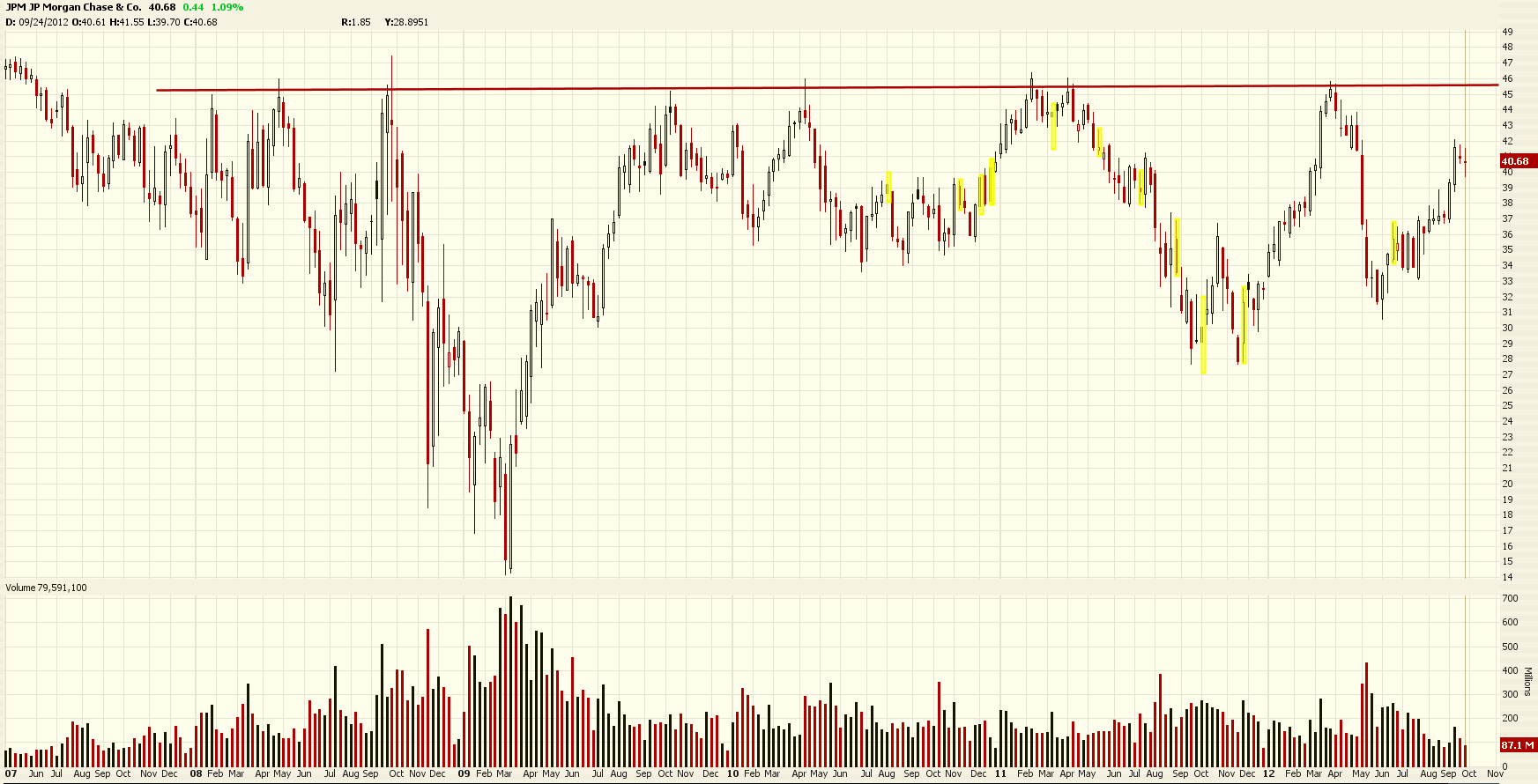
Technical Failures. Perhaps the most obvious sign that JP Morgan was
about to drop, was the consistent technical failure in the charts. Every time JP
Morgan's stock approached $45 or $46, it failed. Looking back all the way to
2007, the $45-$46 level was like a brick wall that completely blocked the stock
every time. This could be one of the easiest bets a short-seller could ever
make. If you just looked at the 5-year chart of JPM in April 2012, you'd notice
that we were approaching major resistance overhead. Every single time we rose to
this level, we fell; and in late 2008, we fell from over $45 to almost
$14.
All one had to
do was see if JPM could break above and stay above $46. If it did, JPM would be
a decent long position at very low risk, with a brand new support at $45. But if
it failed (and it did), JPM would be a good short. This massive resistance was
so powerful, that JPM actually failed once again. Not only that, but it failed
in late March - investors had over a month to notice this and short the stock!
Technicals were signaling a massive warning even before the bad news reached the
public.
(Click
to enlarge)
Conclusion
All of these
facts and clues are still to be determined. JP Morgan may in fact work
everything out and escape with under $10 billion in losses. A lot of what I've
written is opinion based on the available facts, and the probability of the
collapse of a giant financial institution is still extremely low. But there are
simply way too many unresolved issues still to be dealt with; there are way too
many unanswered questions to be answered by Jamie Dimon and
regulators.
JP Morgan was
lucky that the bad news came out right before the summer, and that the "summer
doldrums" helped investors and lawmakers forget about the massive trouble that
may be underway. JP Morgan and CEO Jamie Dimon have been completely silent about
this for a few months now, and the stock has recovered all of its losses since
the news broke out. Technically, this looks like a "pullback" before the next
plunge. The stock may have room to rise, but after such terrible news it is hard
to see how it can sustain new highs. To make matters worse, JPM was included in
Goldman's Hedge Fund Very Important Position list andGoldman Sachs' VIP List of 50 stocks most important to hedge
funds. If JPM suffers, you can bet that most hedge funds, pension funds, and
investors will suffer as well.
I repeat: QE
and central bank stimulus could turn out to be a great success that saves our
economy. But the risks of investing just far outweigh the potential rewards at
this point. If you're smart, you'll avoid or short this market and miss out on a
maximum 7% upside move if stocks continue to rise (and then get in at minimum
risk if we exceed the 2007 highs). By doing so, you'll also save yourself from a
devastating 20-50% drop in stocks if the situation deteriorates. I understand we
all want to grow our wealth and make money through investing in order to improve
our lifestyle, fund our retirement, support our children, and have the ability
to do what we want. But at this point, staying long is just being
greedy.
 The
work of this team garnered such attention, they were brought in front of the
United Nations, U.K. Parliament, and numerous Fortune 500 companies to share
much of their findings. Click
the video above to see a sample.
The
work of this team garnered such attention, they were brought in front of the
United Nations, U.K. Parliament, and numerous Fortune 500 companies to share
much of their findings. Click
the video above to see a sample.